
Vector Labs代理,歡迎訪問Vector Labs官網或者咨詢我們獲取相關Vector Labs產品信息以及報價。
Vector Labs 公司是世界著名的生物學檢測試劑公司,七十年代其在全球首推的生物素-親和素系統引領了生物學檢測方法的重大革命,該系統被普遍視為目前最靈敏、最可靠與最有效的染色系統,并被廣泛應用于免疫組織化學、免疫電鏡、原位雜交與凝集素化學中。該系統仍在不斷地發展,以滿足廣大研究人員的各種不同要求。Vector 公司還是世界上凝集素產品的主要供應商,并提供大量的新產品,如酶底物、神經元示蹤劑及蛋白質、糖類與核酸的標記、分離與檢測試劑。
Griffonia Simplicifolia Lectin I (GSL I) isolectin B4, DyLight? 649
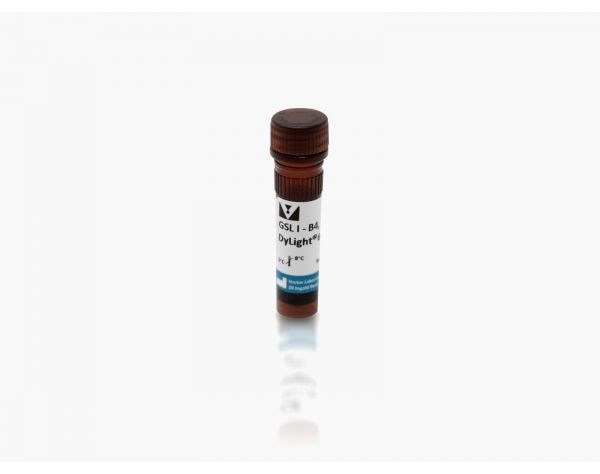
Description
GSL I-B4?isolectin contains only the B subunits. It is a useful marker for endothelial cells from nonprimates such as mouse, rat, rabbit, and goat as well as a marker for non-peptidergic unmyelinated primary afferent neurons. ?This “B”-rich lectin preferentially agglutinates blood group B cells and is specific for α-galactose residues.?
DyLight??649 GSL I-B4?isolectin is produced by using special conjugation procedures to incorporate DyLight??649 into our affinity-purified lectin. This conjugate has an appropriate number of fluorochromes bound which provide the maximum fluorescence and optimum staining characteristics for this particular lectin. This reagent is supplied essentially free of unconjugated fluorochromes and inactive lectin.
- Excitation maximum: ?646 nm
- emission maximum: ?674 nm
- Color: ?Red
Specifications
| Unit Size | 0.5 mg |
|---|---|
| Applications | Immunofluorescence, Glycobiology |
| Recommended Usage | The recommended concentration range for use is 5-20 μg/ml. If a precipitate forms upon long-term storage, warm to 37 oC. |
| Recommended Storage | 2-8 °C |
| Maximum Excitation | 655 nm |
| Maximum Emission | 670 nm |
| Solution | 10 mM HEPES, 0.15 M NaCl, pH 7.5, 0.08% sodium azide, 0.1 mM CaCl2. |
| Concentration | 1 mg active conjugate/ml |
| Conjugate | DyLight 649 |
| Color of Fluorescence | Far Red |
| Sugar Specificity | Galactose |
Documents
- Safety Data Sheet
- Lectins in Histochemistry, ELISA, and Western Blot Applications
- Download CoA
- Datasheet
Product FAQs
Can the biotinylated Lycopersicon esculentum (tomato) lectin be used for in vivo perfusion studies to trace blood vessels in mice?
The Lycopersicon esculentum (tomato) lectin has been widely reported as an effective blood vessel marker for in vivo vascular perfusion studies in rodent species. Investigators have primarily utilized one of the fluorophore conjugated tomato lectin formats to trace blood vasculature in normal and diseased animals via tail vein or intracardiac injection. However, the biotinylated format has also been used. It allows for flexibility in subsequent visualization by way of either fluorescence or enzyme-based methods. Published references are best source for procedural details. Examples of references where biotinylated tomato lectins have been applied via in vivo perfusion are featured below: Robertson, R.T., et al. (2014) Histochem. Cell Biol. 143(2) Thurston, G., et al. (1998) Am. J Pathol. 153(4):1099-1112
Related Products
Griffonia Simplicifolia Lectin I (GSL I) isolectin B4, Fluorescein Catalog #: FL-1201-.5
Galactose Catalog #: S-9003

Griffonia Simplicifolia Lectin I (GSL I) isolectin B4, Unconjugated Catalog #: L-1104-1
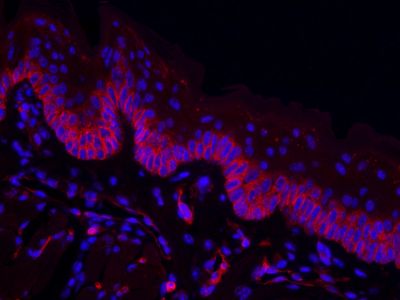
Griffonia Simplicifolia Lectin I (GSL I) isolectin B4, DyLight? 594 Catalog #: DL-1207-.5
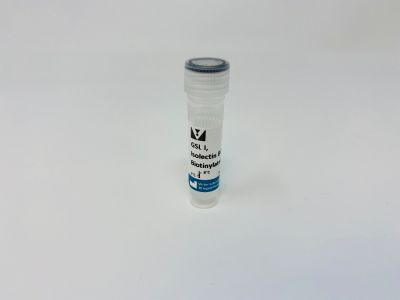
Griffonia Simplicifolia Lectin I (GSL I) isolectin B4, Biotinylated Catalog #: B-1205-.5
Technical Information
GSL I is a family of glycoproteins with molecular weights of approximately 114 kDa. There are two types of subunits, termed A and B, with slightly different molecular weights. These subunits combine to form tetrameric structures, resulting in five isolectins. The A -rich lectin preferentially agglutinates blood group A erythrocytes and thus appears to be specific for α-N-acetylgalactosamine residues, while the B -rich lectin preferentially agglutinates blood group B cells and is specific for α-galactose residues. Our GSL I is a mixture of the five isolectins. GSL I has been reported to bind several glycoproteins including laminin.
Accompanying each fluorescent lectin is an analysis data sheet summarizing the results of our quality control tests and providing pertinent information on the product. All of these reagents are supplied as solutions preserved with sodium azide.
Inhibiting Sugar: 500 mM galactose or 100 mM raffinose